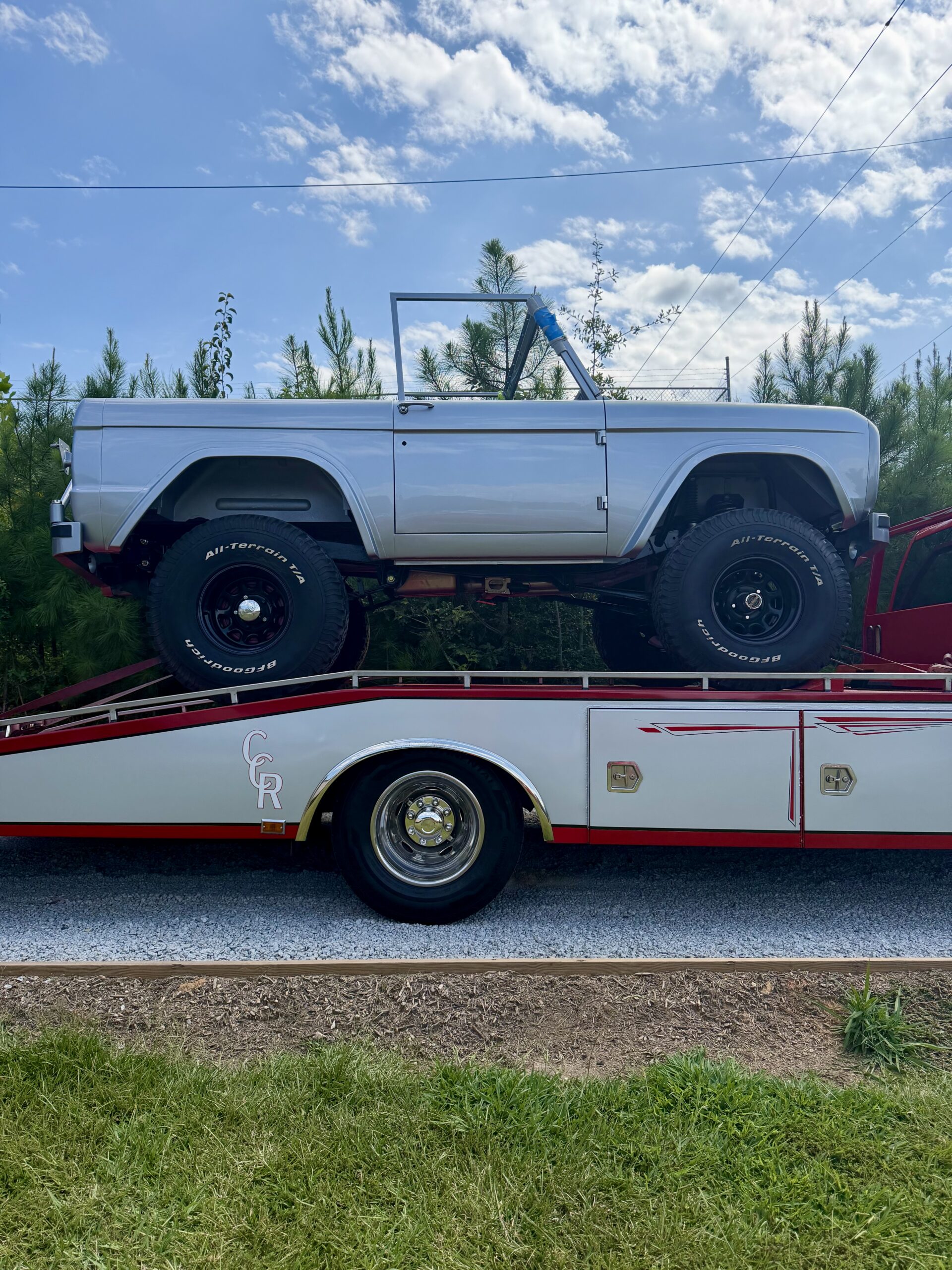
An early Ford Bronco should make you want to take the long way home, not grip the wheel harder whenever traffic speeds up. The 1966–1977 Bronco has a short wheelbase and an upright, unmistakable shape. Those qualities are part of its appeal, but they also make tire size and chassis changes especially noticeable.
The best upgrades work together. More lift or more horsepower rarely solves a Bronco’s biggest road-manners problems on its own.
Start with condition, not the parts catalog
Before choosing upgrades, establish what the Bronco needs repaired. Rust around suspension attachments or body mounts can undermine otherwise good work. Worn steering linkage and wheel bearings can make a healthy drivetrain feel unsettled.
Brake lines deserve attention alongside the brakes themselves. Seat and belt mountings depend on sound structure, too. Tires with plenty of tread may still need replacement because of age or damage.
Dependable starting and cooling come before added performance. Repairing a weak ground connection or sorting out an overheating problem may do more for confidence than an expensive new component.
Choose tire size before lift height
Start with tires that suit your driving, then determine the clearance they require. Larger tires add rotating weight and change effective gearing. They also ask more of the brakes.
For regular road use with occasional trail driving, a moderate tire and restrained lift often make the better combination. Added height raises the center of gravity, affecting stability in corners.
A suspension lift changes steering and driveline geometry. Caster, the steering-axis angle that helps the front wheels track straight, deserves attention afterward. The track bar and drag link also need compatible geometry to reduce bump steer, where suspension movement causes unwanted steering input.
A body lift raises the body above the frame, but adds neither suspension travel nor axle clearance. Neither type of lift increases clearance beneath the axle differentials; taller tires do that.
Check tire clearance through suspension movement and steering travel, not just while parked.
Improve brakes and steering as complete systems
For a drum-brake Bronco, a properly engineered front disc conversion can improve resistance to fade during repeated stops. Discs shed heat more effectively, but the conversion still needs a compatible master cylinder and appropriate front-to-rear brake balance.
Power assistance reduces pedal effort. It does not automatically shorten stopping distances or compensate for poor tires.
Power steering makes parking and slow trail maneuvers easier, particularly with larger tires. It cannot remove wander caused by worn linkage or incorrect geometry. Steering-box mounting strength matters as well, because power assistance introduces loads that the mounting structure must handle.
The target is predictable response, not merely a lighter steering wheel. Diagnose looseness before choosing parts to cover it up.
Match axle gearing to tires and transmission
Taller tires effectively make the gearing taller. A Bronco may become sluggish pulling away or require more clutch slipping on a slow trail section. An automatic may downshift more often on grades.
A numerically higher axle ratio can recover some of the leverage lost to taller tires. The right ratio depends on transmission gearing as well as tire diameter, so a recommendation without that context is incomplete.
Overdrive can lower highway engine speed, but lower rpm is not always better. The engine still needs enough leverage to hold speed without laboring or repeatedly downshifting.
Front and rear axle gearing must also be compatible for four-wheel-drive use. Settle tire size before committing to axle gears.
Choose fuel injection for a clear reason
A healthy, properly tuned carburetor can serve an occasionally driven Bronco well. Electronic fuel injection becomes more appealing when easier starting or adaptation to elevation changes matters. It can also handle steep trail angles better than many carburetor arrangements.
The installation determines much of the result. EFI requires the correct fuel pressure and dependable electrical power, along with suitable calibration. A poorly installed system can introduce problems rather than solve them.
Fuel injection cannot repair worn engine internals or cure inadequate cooling. If the existing engine suits the vehicle, improving its fuel delivery may be enough without an engine swap.
Keep the details that make it yours
Originality is not an all-or-nothing decision. Factory-style upholstery can coexist with improved brakes. A familiar dashboard can stay while electrical faults are repaired. A restrained stance can still provide useful trail capability.
Decide what you enjoy about the Bronco before changing it. If its engine character and simple cabin are central to the experience, preserve them and concentrate on the systems that make driving more predictable. Better control is worthwhile, even though these upgrades do not provide modern crash protection.
At Classic & Custom Restorations in Dallas, Georgia, we restore and modernize classic Broncos. Talk with us about your highway driving and trail plans, and we can help shape a build that feels like your Bronco, only better sorted.